Modern Movement Australia
Modern Movement Australia is the infrastructure programme behind Sunshine Australia’s economic policy. It is not a separate organisation and it is not a slogan — it is the physical build that the Resource Extraction Levy pays for, and the reason the party’s energy, water, housing and freight policies are able to say what they say.
The engineering work sits on a separate site, Modern Movement Australia, because it is a body of technical work in its own right. This page is the summary. If a policy on this site refers to corridor power, sovereign water to the mine gate, or freight on the inland spine, this is the thing it is referring to.
Modern Movement Australia is a multimodal elevated viaduct — electrified freight, 600 km/h maglev passenger, HVDC transmission, water, gas, hydrogen and sovereign fibre — built above Australia’s existing rail, road and transmission corridors. Seven services on one structure. The freight line pays for everything above it.
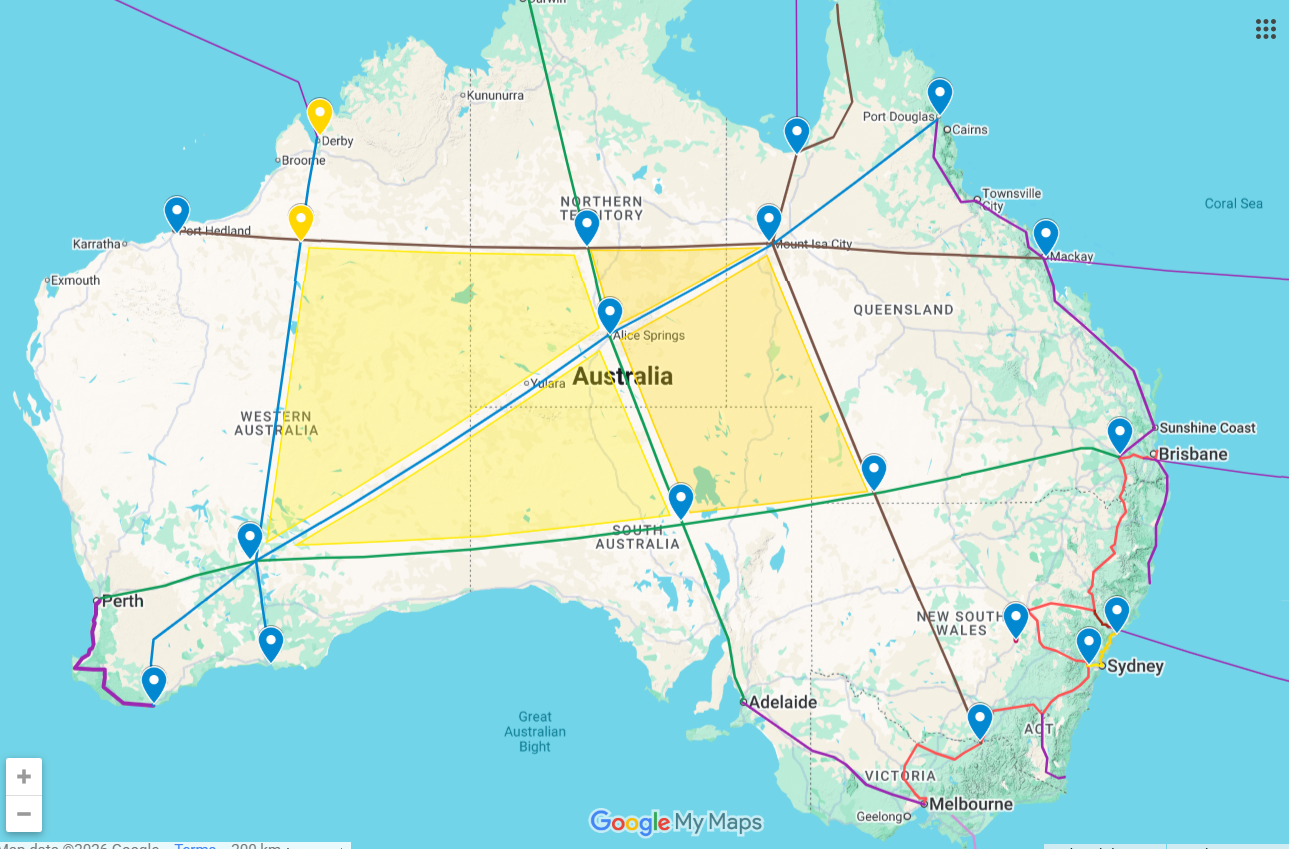
Phase 0 runs Melbourne to Brisbane — 2,290 kilometres of inland spine, with a 111 km spur to Newcastle, complete by 2035. The Sunshine Australia ask is a change of direction, not new money: redirect the $93 billion already committed to the HSRA tunnel into Phase 0 instead. Same year, same money, a different country. Phase 0 delivers Melbourne–Brisbane before the HSRA delivers even its first Sydney–Newcastle stage in 2042.
The economics come from carrying seven services on one structure — roughly $148–235 million per kilometre, against about $474M/km for the HSRA’s single passenger service. It is built almost entirely on existing rail reserves and easements: zero tunnels, zero national parks, farmland leased rather than compulsorily acquired. The freight line commissions at month 20 and earns revenue from year 3, funding the maglev built above it — government invests in one thing, and everything above it is commercially self-funded.
It is a sovereignty play as much as a transport one. The backbone removes diesel-road dependency on the export routes, carries up to 30,000 gigalitres a year of continental water transfer to drought-proof the Murray–Darling via the Alice Hub pumped-hydro system, and moves 72 GW of HVDC power from stranded renewables to load centres and export. The buildable architecture is protected by the Anchor Tension System (ATS) Patent Family — five Australian provisional patents filed in April 2026 — owned in Australia, before construction begins.
Phase 0 is the spine; the national network completes itself. Once Phase 0 is operational, six transcontinental corridors follow in sequence — roughly 22,400 kilometres, eleven new inland cities, every capital-city airport and major port connected — each corridor funded from the operating revenue of the one before.
The full engineering, economics and documents live on Modern Movement Australia site.