NO FUEL, NO FOOD
There are a lot of people spruiking AUKUS, and no wonder — it is an enormous amount of business. You can imagine what it takes to stop a machine like that. But facts are facts.
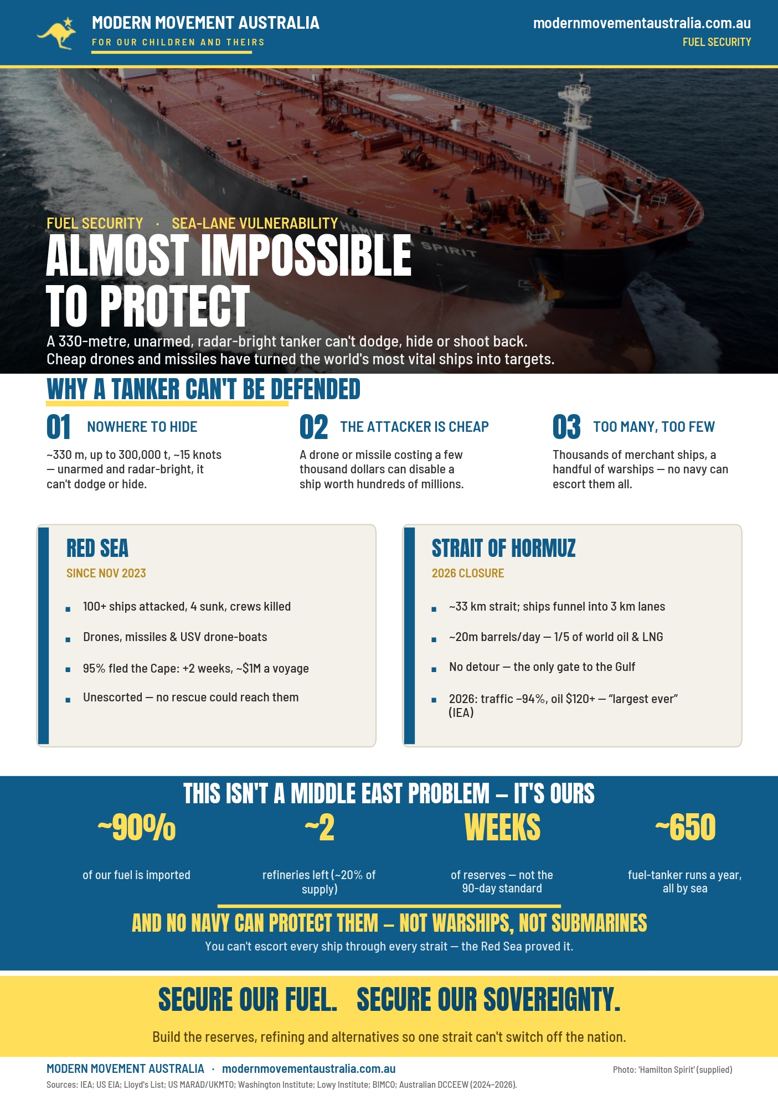
A tanker is 330 metres long, unarmed, radar-bright, and does about fifteen knots. It cannot dodge, hide or shoot back. A drone or missile costing a few thousand dollars can disable a ship worth hundreds of millions. And there are thousands of merchant ships against a handful of warships — no navy can escort them all. The Red Sea proved it: more than a hundred ships attacked, four sunk, crews killed, and most traffic fleeing around the Cape at two extra weeks and about a million dollars a voyage.
Hormuz shows the same vulnerability, and it is not a Middle East problem. It is ours. In a regional war, tanker traffic is the first thing to stop. It becomes a blockade, and the nation that lasts longest wins.
The problem is that no fuel means no food. That is especially true here. We hold no meaningful food reserve — the whole system is just in time. Remember when the Nullarbor flooded and the rail and highway were cut? Within days, food and medicine started running short in the West. That was weather, not a war.
Now imagine a blockade, or a conflict over Taiwan. Even if we are not involved, the tankers stop, and the diesel follows very quickly.
Which is the whole problem with AUKUS. Hundreds of billions on submarines and ships that cannot keep the tankers coming. They cannot escort the traffic we need every month, and in a real conflict those ships may already be sunk or sitting in port because no owner will sail them.
The only real solution is to spend that money at home: internal production and sustainability. Converting the fleets to electric and biodiesel, rebuilding refining, building reserves — and holding a food store, just in case. The world is not getting safer. We should be preparing at home before we buy shiny weapons for someone else’s fight.